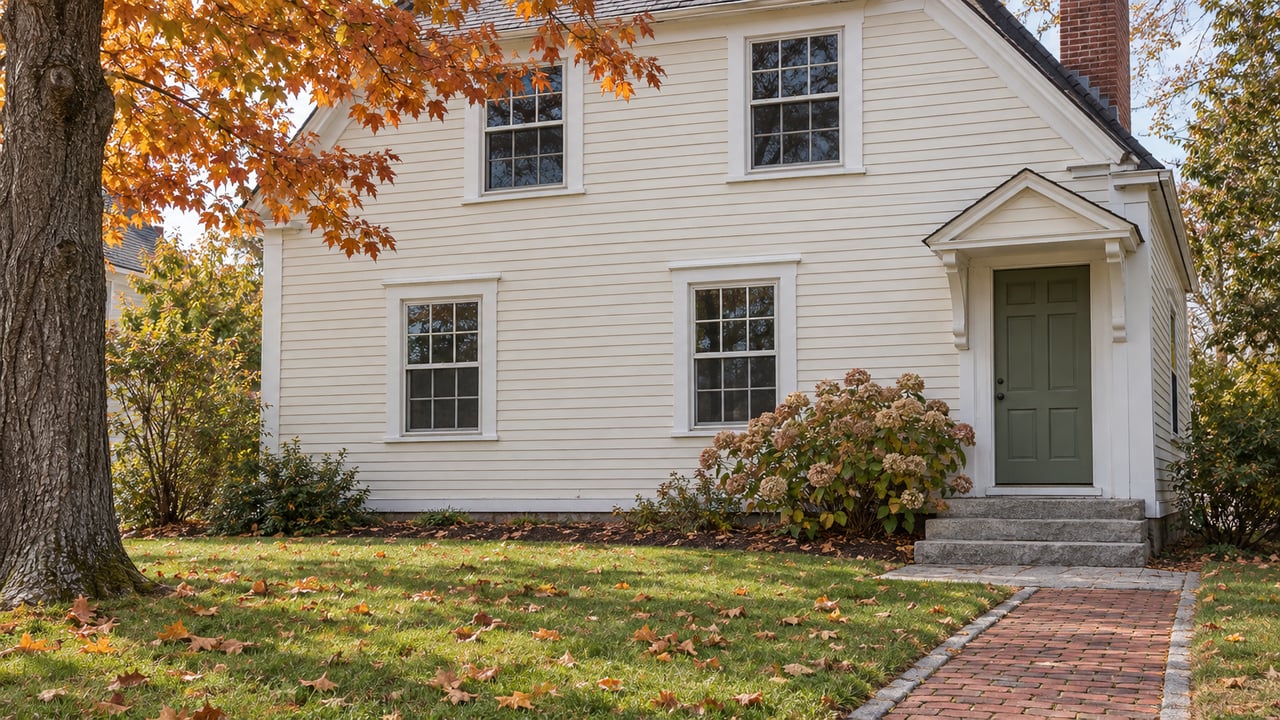
A few years back, a business owner who'd finally found a foothold on Hadley's Route 9 corridor described the town's housing supply to BusinessWest in a single line: at any given moment, there are maybe five or six houses on the market, and they're expensive. That was 2024. Ask around town today and you'll hear some version of the same complaint, because the underlying math hasn't changed.
Most people assume a town this size, with roughly 5,000 residents spread across farmland and a couple of commercial strips, should have a looser market than its neighbors. Hadley doesn't. And the reason isn't mysterious once you look at how the town actually decided to grow.
The town made a permanent choice about its land
Hadley's own land use survey states it plainly: the town has permanently protected roughly 22 percent of its total area through the Agricultural Preservation Restriction program, more than any other community in Massachusetts.
That single fact reframes everything about how to read this market. When a town caps its buildable residential land through in-perpetuity restriction rather than through zoning that could loosen with the next planning board vote, supply doesn't respond to demand the way a normal housing market does. Prices can climb, interest can spike after a good school year or a UMass hiring cycle, and the land base still won't grow. Roughly 3,065 parcels make up the entire town, and once you subtract what's permanently set aside, the residential inventory that ever gets built out is smaller than the town's overall footprint suggests.
Here's how those parcels break down, according to the town's own assessor data:
| Land use category | Share of parcels |
|---|---|
| Residential | 59% |
| Farm and forest land | 15% (about two-thirds under permanent or long-term protection) |
| Commercial, industrial, and mixed use | 8% |
| Everything else (municipal, vacant, other) | Remainder |
That 15 percent farm and forest slice is where the APR concentration lives, and it's not incidental. It's the direct result of a strategy Hadley wrote into its own zoning bylaw.
Hadley built commercial strips on purpose, to keep the farms
The town's zoning history describes something planners call a transfer of development rights: landowners in the agricultural district can certify development rights on farmland, then developers in designated commercial zones can buy those rights to add density or reduce parking requirements on their own projects. In exchange, the farmland gets a permanent APR. The town's land use survey calls this out directly, noting that Hadley used its commercial zoning strips along Routes 9, 47, and 116 in part as a defensive mechanism to keep the rest of the town's farmland out of subdivision pipelines.
It worked, in the sense that the farms are still there. It also produced the auto-oriented commercial strip that anyone driving Route 9 through Hadley recognizes immediately, the corridor with the shopping plazas, the car dealerships, the fast food, and, further along, the hotels and cannabis dispensaries. The tradeoff was deliberate. Density and commercial intensity got pushed onto three highway strips so the interior farmland could stay farmland, permanently. If you're comparing Hadley to a neighboring town with more scattered zoning, this is the structural difference that raw population and acreage numbers won't show you.
What that means in today's numbers
As of August 2026, the median list price for a home in Hadley sits at $610,000. Looking at actual closed sales over the trailing twelve months through this spring, the median landed closer to $559,000, itself down about five percent from the prior twelve-month period. Those two numbers aren't a contradiction. They're two different windows on the same tight market: what sellers are asking right now, and what buyers have actually paid over the past year as some of that asking-price optimism gets negotiated down.
What hasn't moved much is the pace. Houses in Hadley have been closing in roughly a month, well under the pace of a typical national listing. In a market with a structurally capped residential land base, that's the signature you'd expect. Demand doesn't need to be unusually hot to clear a small, permanently limited supply quickly. It just needs to show up.
This is also why the "five or six houses" description from 2024 still tracks. It isn't a snapshot of a single bad month. It's a description of what a town with 22 percent of its land permanently taken off the residential table looks like, year after year, regardless of what mortgage rates are doing.
The corridor itself is mid-transformation
The commercial strip that absorbed Hadley's development pressure is currently under construction, and has been for years. The $28.2 million Route 9 widening project, stretching about 2.4 miles from the town center at Middle Street east to the North and South Maple Street intersection near the malls, began construction in 2022 and was on track to wrap up this spring. Businesses along that stretch, including Hillside Pizza and Wanczyk Nurseries, have operated through years of lane shifts and detail officers directing alternating traffic. One property didn't survive the project at all. The former Exotic Automobile Repair site at 184 Russell Street was taken entirely to make room for the new roadway and intersection design.
The disruption was significant enough that it helped prompt formation of the Hadley Business Council, a group that now meets monthly and has worked directly with MassDOT and the general contractor to keep signage clear about which businesses remain open during construction.
Just as that project nears its finish line, a second one has started. Reconstruction of the Route 47 bridge over the Fort River on Bay Road, originally built in 1935, got underway this spring after being postponed more than six years so it wouldn't overlap with the Route 9 work. The $6.8 million project is expected to take three-plus years to complete. Bay Road is one of the main east-west connections over the Connecticut River in Hampshire County, linking Hadley to South Hadley, Belchertown, and Granby, so this isn't a side-street repair. It's a multi-year construction zone on a route a lot of Hadley commuters and residents in the surrounding towns already use daily.
For anyone weighing Hadley against a neighboring town right now, that's worth factoring in alongside the price. You're not just buying into a permanently constrained land supply. You're buying into a commercial and transportation backbone that's actively being rebuilt, with one major piece nearly finished and another just getting started.
What this actually means if you're comparing towns
None of this makes Hadley a bad choice. It makes Hadley a specific kind of choice, one where the tradeoffs are baked into the town's own zoning history rather than left to chance. Farmland stays farmland here in a way it doesn't everywhere in the Pioneer Valley, and that has real value if working landscape and open sightlines to the Connecticut River valley are part of why you want to live here in the first place. It also means the interior residential lots that do exist carry a scarcity premium that isn't going away, because the mechanism behind it is a permanent restriction, not a market cycle.
If you're cross-shopping Hadley against Amherst, Hatfield, or Northampton, the question worth asking isn't just what the median price is. It's what share of each town's land is actually available to ever become a house, and how that compares to what you're seeing on the listing sheet today.
A few questions that come up often
Does the APR-protected farmland affect what I can do with a property I buy? Check the specific parcel's status during due diligence.
Will the Route 47 bridge project affect my commute if I buy in Hadley? If your route to work uses Bay Road between Hadley and South Hadley, Belchertown, or Granby, expect construction-related delays for the multi-year life of that project. Routes through the town center or Route 9 corridor won't be affected by this particular job.
Understanding a market like this takes more than pulling a median price off a portal. It takes knowing why the number looks the way it does. If you're weighing Hadley against another Pioneer Valley town, Ashton Realty Group can walk you through what a specific property's zoning and land status actually mean before you write an offer. Reach out for a free home valuation and a conversation grounded in what's really driving this market.
This article is general information, not legal, tax or financial advice. Consult a qualified professional about your situation.